The back story
Coffee with a crater view: the Canaries’ café culture, the back story
A literary society of 1844, Manrique’s cafés in the lava and the coffee of Agaete.

Photo Credit
Image courtesy of © Edmundo Sáez · CC BY-SA 4.0 via Wikimedia CommonsWhy does a café in the Canaries so often come with a view, a society or a volcano attached? Because the islands’ best coffee stops were built for something else first: a literary club in Las Palmas, a clifftop lookout, a quarry, a bay. Here is the back story of four of them, and of the coffee grown in Agaete, checked against the venues’ and the government’s own pages in November 2026.
A club of 1844
The oldest coffee ritual in these pages belongs to a club. The Gabinete Literario was founded in Las Palmas on 1 March 1844 as the Gabinete Literario de Fomento y de Recreo, by four Gran Canarians: Cristóbal del Castillo y Manrique de Lara, Domingo J. Navarro, Juan Evangelista Doreste and Antonio López Botas. Its first elected president was Roberto Houghton.
It was never only a place to sit. By its own account the society set out to do more than entertain, founding a school and a philharmonic orchestra, and in 1910 it sponsored the city’s first Juegos Florales, the poetry contest at which Miguel de Unamuno was present. Few cafés can claim a philosopher among the audience.
The building on Plaza de Cairasco wears two towers crowned by exotic domes and a modernist façade by the architects Fernando Navarro and Rafael Massanet. Upstairs, the Salón Dorado, the old ballroom, has three ceiling canvases by Manuel González Méndez: Apollo, Orpheus and Thalia. Downstairs, the Gabinete Literario terrace serves its restaurant’s cooking outdoors, in the historic heart of the city.
Coffee in a cliff
On Lanzarote, the café habit was redesigned by an artist. César Manrique’s Mirador del Río was begun in 1971 and opened in 1973, dug into the top of the Risco de Famara and covered with volcanic stone so that, from outside, the building all but disappears. Eduardo Cáceres and Jesús Soto worked on the project with him.
Photo Credit
Image courtesy of © Gabinete LiterarioInside, two arched windows frame El Río and the Chinijo Archipelago, with La Graciosa facing the cliff. The Mirador del Río Café occupies one of the interior spaces and serves aperitifs, Lanzarote wines and the barraquito, the layered coffee of the islands. It is the rare café where the view is the main course and the cake is a side.
A quarry with a café
The Jardín de Cactus at Guatiza began as a rofera, a quarry for volcanic material that was also used as a landfill. Manrique’s project took two decades to develop and turned it into a garden of nearly 500 species from five continents, with one of the last traditional maize mills on the island standing at the top. The cactus garden began life as a hole in the ground that people threw things into.
The cactus garden began life as a hole in the ground that people threw things into.
The Jardín de Cactus café has high chairs for families, and the rule is firm: no outside food or drink in the garden. The plants, after all, were there first, and most of them are armed. The café is the only picnic the garden allows, and the view of the spines comes with it.
On Arrecife Bay, Islote de Fermina, designed by Manrique in the 1970s and recently restored, houses the Arrecife Bay Interpretation Centre and a café open from 10am to 12.30pm; Brunch Fermina runs at weekends, at 10am or 11am, booked online only, at €33. The islet stays open until midnight Thursday to Saturday, the rare Manrique space where coffee can turn into dinner.
Beans from Agaete
They grow it, too. Coffee growing in the Agaete valley on Gran Canaria is documented from the 19th century and won a bronze medal at the Paris Universal Exhibition of 1889, the Government of the Canary Islands notes. In August 2026 its bid to become a protected geographical indication, Café de Agaete, went on towards the European Commission. A medal-winning bean of 1889 is now, very patiently, waiting for its paperwork.

Photo Credit
Image courtesy of © Alchemist-hp (www.pse-mendelejew.de) · CC BY-SA 3.0 via Wikimedia CommonsOur advice: order the barraquito at the Mirador, lunch on the Gabinete’s terrace, and drink your coffee on island time. The Canaries keep UTC+0, an hour behind mainland Spain, so the morning coffee at the Mirador (open daily from 10am, last entry 4.40pm) is an hour later than Madrid’s, and the view of La Graciosa is the same either way.
Why it's on our list
- A club of 1844
- Coffee in a cliff
- A quarry with a café
- Beans from Agaete
Location
The map comes from Google Maps, which sets its own cookies once it loads.
More in depth
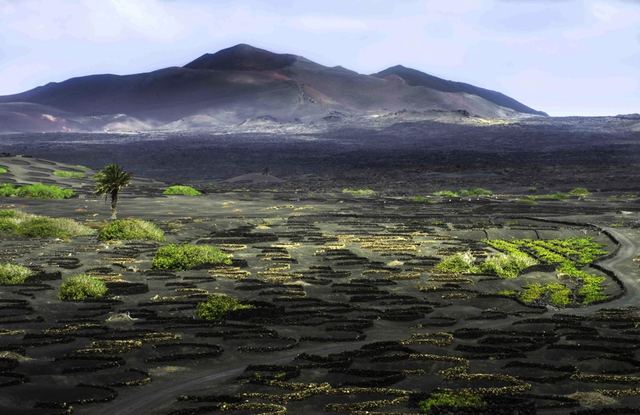 The back storyWine from the ash: how the Canaries learned to drink, the back storyVines dug into volcanic ash, a winery of 1775, a bar of 1974 and Shakespeare’s cup of canary.
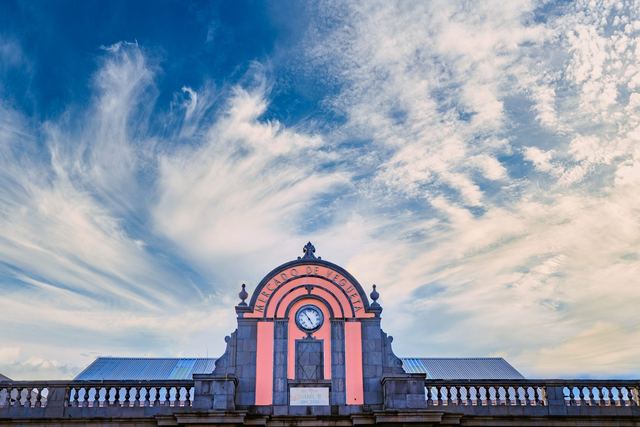 The back storyFrom the Guiniguada to Las Canteras: how Las Palmas shops, the back storyA market built from 1856, a street named after Seville’s Triana, and a mall open on Sundays.
 The back storyGrids, cobbles and cloud forest: walking the Canaries, the back storyLa Laguna’s grid that crossed the Atlantic, the camp that became Las Palmas, and Garajonay’s mist.