Objects of Desire
Berths on the trade winds: the Canaries’ marinas
Four marinas from Arrecife to Costa Adeje, the ferry that carries your car, and a regatta.

Photo Credit
Image courtesy of © Marc Ryckaert · CC BY-SA 4.0 via Wikimedia CommonsWhat does a beautiful machine look like on islands with more ocean than motorway? It floats. The Canaries’ finest engines are moored, not parked: in a marina built for Tenerife’s first tourist boom, a private harbour on Gran Canaria, and two on Lanzarote. Here is how they compare, and how to take your own car between islands, checked against the marinas’ and operators’ own pages in November 2026.
A boom in the south
On these islands the thoroughbreds are measured in metres of length, not cylinders. The motorways are short and the ocean is not, so the serious machinery of the Canaries tends to sit on pontoons, white hulls in rows, waiting for the trade wind. Why does a guide to beautiful machines start at the water’s edge? Because here the road runs out long before the ambition does.
Puerto Colón, on Tenerife’s south coast near Playa de las Américas and Costa Adeje, was built in the 1980s, the marina says, as part of the tourism expansion that began on the island in the 1960s and 1970s. It has been upgraded in several phases since, and today offers berths, a fuel station, a boatyard and dry-dock storage, with 20 apartments and a pool of its own. The hotels look down on the masts.
Six metres to forty-five
On Gran Canaria, Puerto Deportivo Pasito Blanco sits at Urbanización Pasito Blanco on the GC-500, in San Bartolomé de Tirajana, two kilometres from Maspalomas Costa Canaria and Meloneras. It has 388 berths for boats from 6 to 45 metres in length, 115 places in its dry marina, a boatyard with 25 new spaces and VIP services for superyachts.
The marina keeps the La Punta Yacht Club, with boat hire and sales on the quay. Forty-five metres is the ceiling here, which is roughly the point at which a yacht stops being a boat and starts being a staff. Below it, the range runs down to six metres, so the dinghy and the superyacht share the same breakwater, if not the same conversation.
Lanzarote’s two harbours
Lanzarote keeps a marina at either end of its volcanoes. Marina Lanzarote, on Avenida Olof Palme in Arrecife, has 380 moorings across more than 14,000 square metres, with over 400 parking spaces, shops, fitness and restaurants. It sits in the historic maritime setting of the capital and calls itself the first marina offering a full range of services on arrival in the Canary Islands.
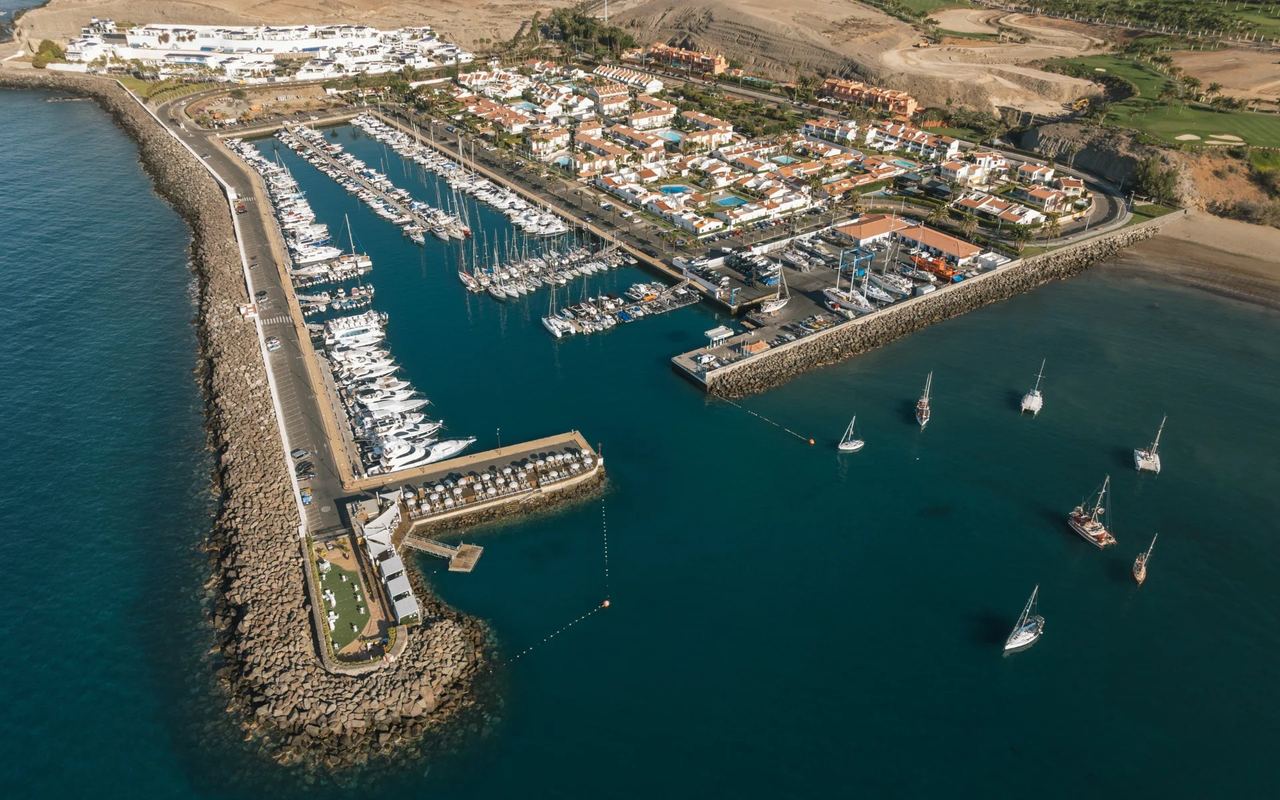
Photo Credit
Image courtesy of © Puerto Deportivo Pasito BlancoMarina Rubicón, at Playa Blanca in the south, opened in 2003 between the Los Ajaches natural monument and the town, and has kept improving its services since, it says. Its village of restaurants, shops and boutiques around the pontoons is a reminder that most people who visit a marina are there to look at boats, not to own them, which is by far the cheaper hobby.
On these islands the thoroughbreds are measured in metres of length, not cylinders.
Which harbour suits which boat? The figures answer for themselves: Pasito Blanco for the long hulls, up to 45 metres; Marina Lanzarote for numbers, with 380 moorings in the capital; Marina Rubicón for the village life ashore; Puerto Colón for a berth at the foot of the resort. The choice is less about engines than about what you want to see when you step off.
Taking the car across
For four wheels, the machine that matters is the ferry. Fred. Olsen Express crosses between Agaete on Gran Canaria and Santa Cruz de Tenerife in 80 minutes, and offers savings for two to five passengers travelling with a car. Vehicles must be at the dock ready to board 40 minutes before departure, foot passengers 20 minutes; for inter-island trips you need only the ID you used to buy the ticket.
Photo Credit
Image courtesy of © Marina LanzaroteFred. Olsen Express also runs Los Cristianos to San Sebastián de La Gomera and Corralejo on Fuerteventura to Playa Blanca, which delivers you almost to the pontoons of Marina Rubicón. Armas Trasmediterránea, now part of Baleària Canarias, sails from Los Cristianos to La Gomera and from Las Palmas to Morro Jable. Between them, the islands become one long coast road with gaps of sea.

Photo Credit
Image courtesy of © Luis Miguel Bugallo Sánchez (Lmbuga) · CC BY-SA 3.0 via Wikimedia CommonsIf you would rather hire than ship, Cicar rents cars across the islands, at all the airports, the sea ports and the main holiday areas, with pick-up and return at your hotel, from its head office in San Bartolomé on Lanzarote. Our advice: on Lanzarote, drive from one marina to the other; the road between them is a fine introduction to the island, and both ends have somewhere to sit and watch the boats come in.
Why it's on our list
- A boom in the south
- Six metres to forty-five
- Lanzarote’s two harbours
- Taking the car across
Location
The map comes from Google Maps, which sets its own cookies once it loads.
More in depth
 Objects of DesireLava, trencadís and a lake: the Canaries’ concert hallsCalatrava’s white wave in Santa Cruz, Manrique’s hall in a lava tube and a theatre renamed in 1901.
 Objects of DesireThe biggest eye in the Atlantic: La Palma’s telescopesA 10.4-metre mirror in 36 pieces, first light in July 2007, and twenty more instruments around it.
 Objects of DesireLiving inside the lava: César Manrique’s housesA house in five volcanic bubbles, a studio left as it was in 1992 and a lookout dug into a cliff.